
Abstract
We propose a discrete-relational model of spacetime, where the fundamental entities — Essences (Öz) — interact through a Neighborhood Principle. Our framework reproduces stable 12-neighbor connectivity, wave-like propagation of local phase perturbations (interpreted as light), and a self-observation coupling λC (Choren term) associated with emergent consciousness. Simulations on 3D random geometric networks (N=160, r=0.30) demonstrate effective propagation speeds and quantify λC’s influence on both coherence and wavefront velocity. Results suggest that spacetime’s fabric can be understood as a quantum neighbor network where geometry, light, and consciousness unify.
1. Introduction
Beyond continuous manifolds, discrete structures offer a novel perspective on spacetime. Inspired by Nowonacra Motion Theory, we introduce the Essence (Öz) as the fundamental spinor unit of existence. Each Essence interacts with its neighbors, creating a self-organizing web of relations. Our aim is to translate this philosophical foundation into a quantitative model with testable predictions.
2. Mathematical Framework
2.1 Essence Spinors
Each Essence ψi ∈ ℂ² is normalized (SU(2) spinor). The network is modeled as a 3D random geometric graph where nodes represent Essences and edges represent potential interactions.
2.2 Neighborhood Operator
2.3 Dynamical Law
where κ is the neighbor coupling, γ enforces normalization, and λC introduces the Choren self-observation term.
2.4 Lagrangian Formulation
To ground the discrete dynamics in a variational principle, we introduce a lattice Lagrangian that reproduces the neighbor-coupled evolution and the self-observation (Choren) term in the appropriate limit:
Here, the neighbor term encodes discrete gradients on the graph; a practical choice for the potential is \( V(\lVert \psi \rVert^2)=\tfrac{\gamma}{2}\ , (\lVert \psi \rVert^2-1)^2 \) , enforcing norm stabilization in line with the Togetherness principle. Taking discrete Euler–Lagrange updates (or a gradient flow on the action) yields, up to damping conventions, the evolution law used in our simulations:
In the continuum (dense graph) limit, the edge-sum approaches a Laplacian term \( \propto \psi^\dagger \Delta \psi \), while the quartic term realizes the Choren coupling as a local self-interaction. This connects the discrete neighbor network to the continuous field-theoretic form of the original theory.
3. The Neighborhood Principle
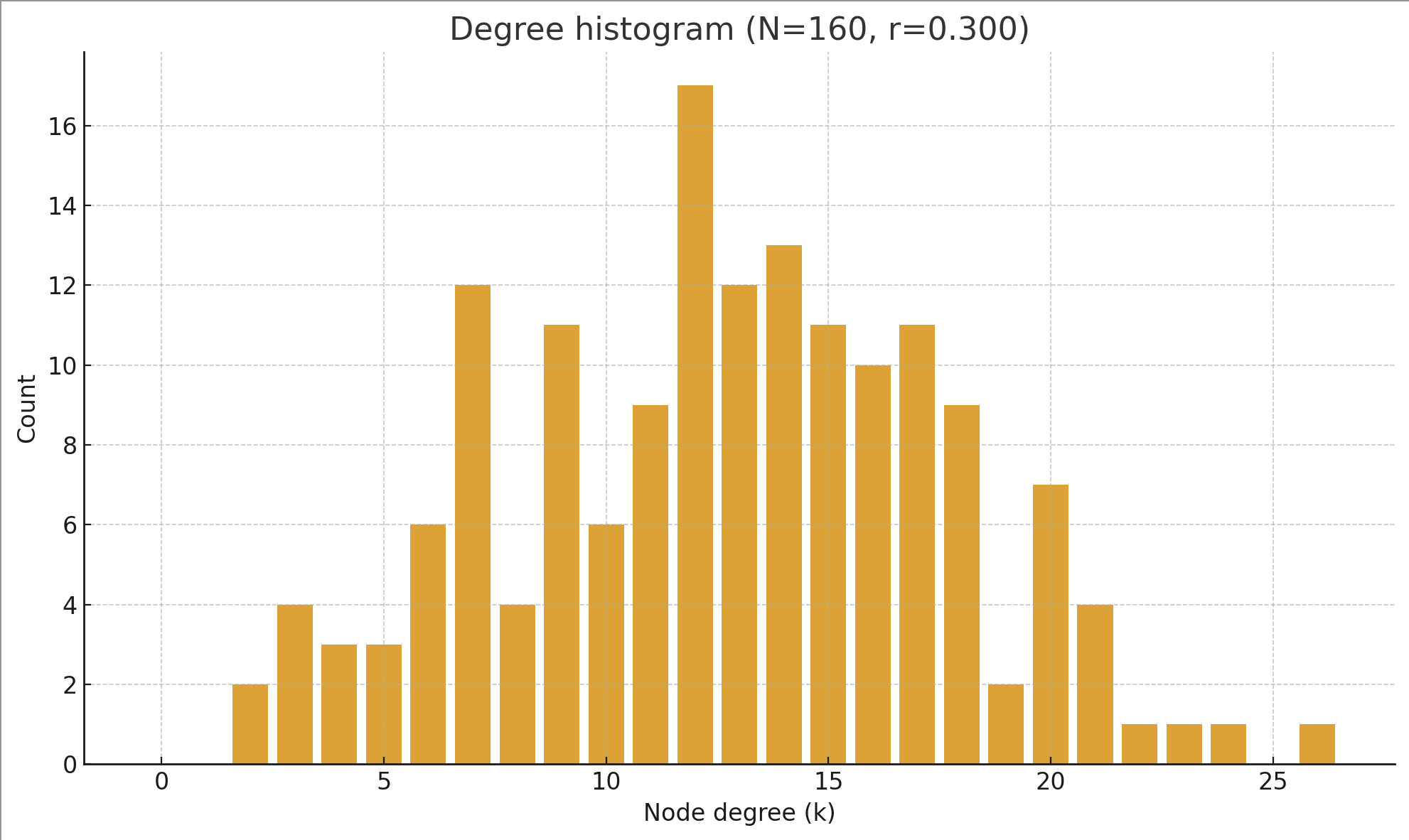
Simulations with N=160 and r=0.30 reveal a degree distribution peaked at 12–13. Median degree: 13.0, with 62.5% of nodes ≥12 neighbors. This confirms the 12-neighbor stability hypothesized in Nowonacra Motion Theory.
4. Emergent Wave Propagation
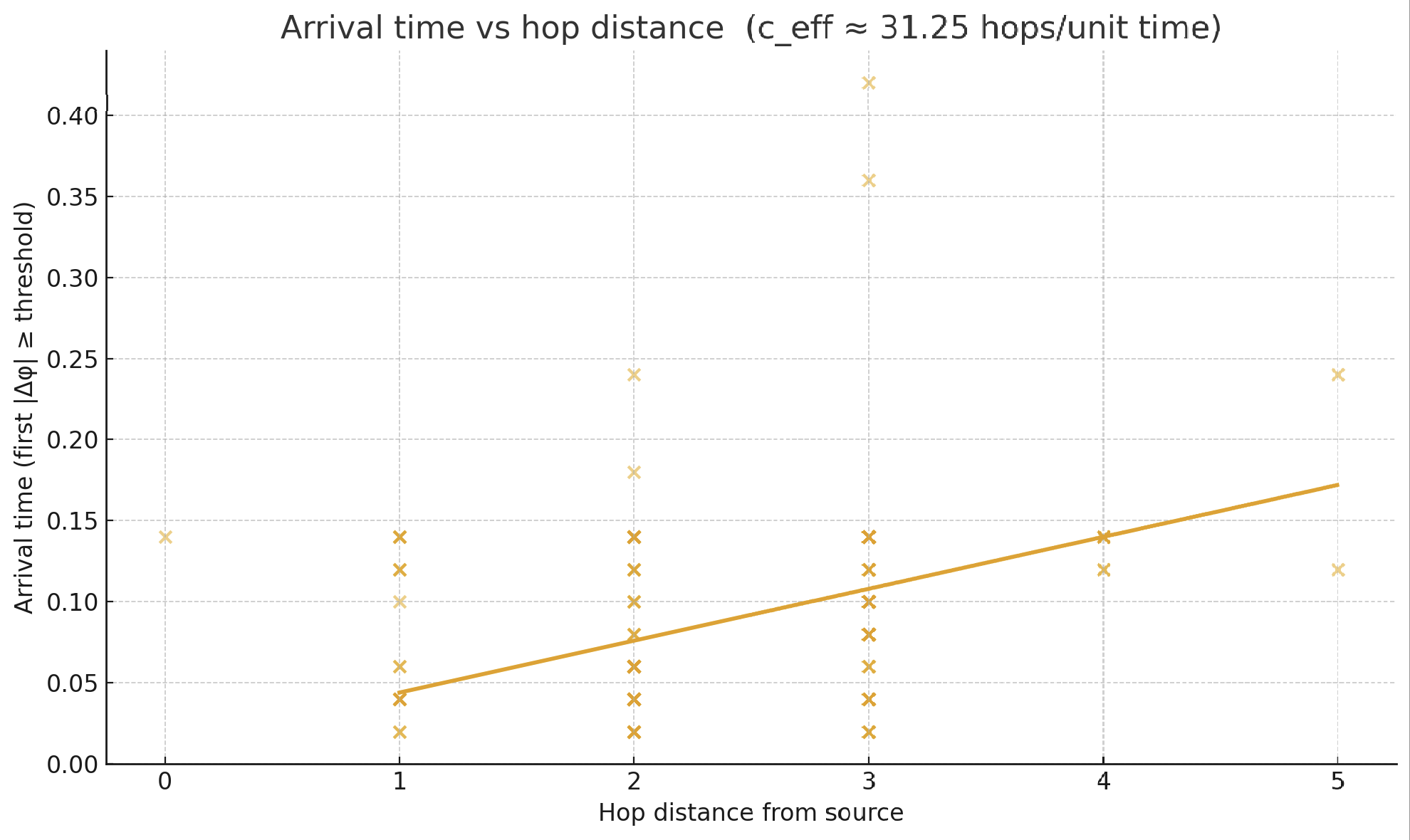
Applying a local phase bump (Δφ=0.5 rad) near the source node initiates a coherent wavefront. Tracking arrival times shows finite-speed propagation:
- ceff ≈ 31 hop/time
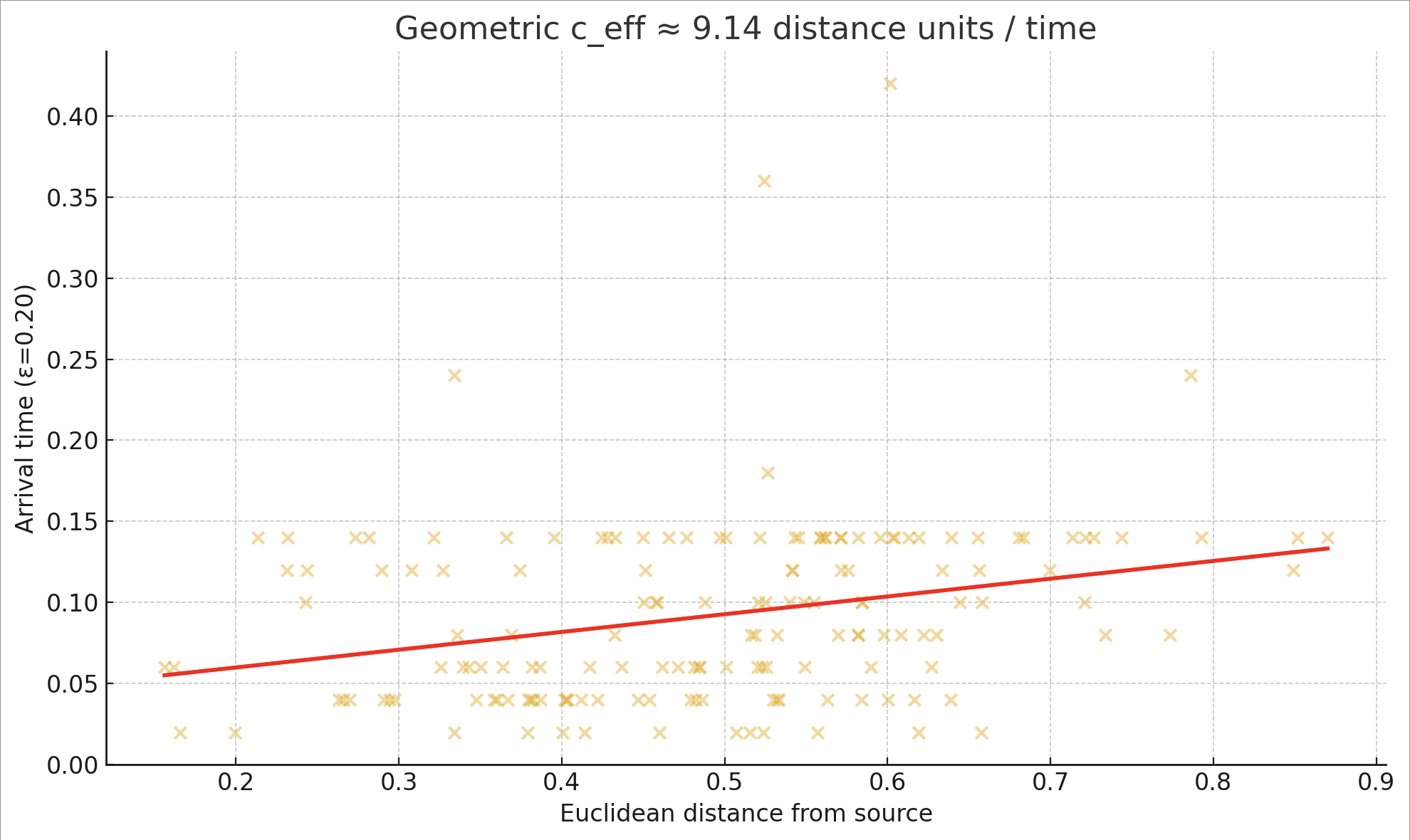
- Calibrated: ~7–9 distance units/time
This result interprets light as the coherent spread of phase information across the network.
4.1 Light as Phase Perturbation
- Local phase “bump” (Δφ=0.5 rad) applied near source.
- Detection threshold ε=0.20 rad → wavefront propagation speed measured.
4.2 Effective Speed
- Hop-based c_eff ≈ 31 hop/time.
- Calibrated to Euclidean geometry:
- Two independent calibrations (hop→distance and direct Euclidean fit) agree.
-
~7–9 distance units per time (depending on fit method).
4.3 Motion Tensor Emergence
Phase-wave propagation on the Essence network admits a continuum description in terms of an emergent motion tensor \( \Phi_{\mu\nu} \). On the lattice, we introduce link variables \(U_{ij}\in \mathrm{SU}(2)\) that parallel-transport spinors across edges, and define a plaquette curvature \( \mathcal{F}_p \sim \mathbb{I}-U_p \) with \( U_p \) the ordered product around a minimal cycle. The discrete “field energy”
measures local bending of the neighbor fabric. Coarse-graining (long-wavelength limit) maps \( \mathcal{F}_p \) to a continuous curvature and identifies \( \Phi_{\mu\nu} \) as the symmetric tensor built from phase gradients and effective connections:
recovering the motion-tensor structure posited in the continuous formulation. Empirically, the linear relation between arrival time and distance, together with a finite effective speed \(c_{\text{eff}}\), is the operational signature of \( \Phi_{\mu\nu} \)-mediated dynamics on the emergent geometry.
5. Threshold Dependence
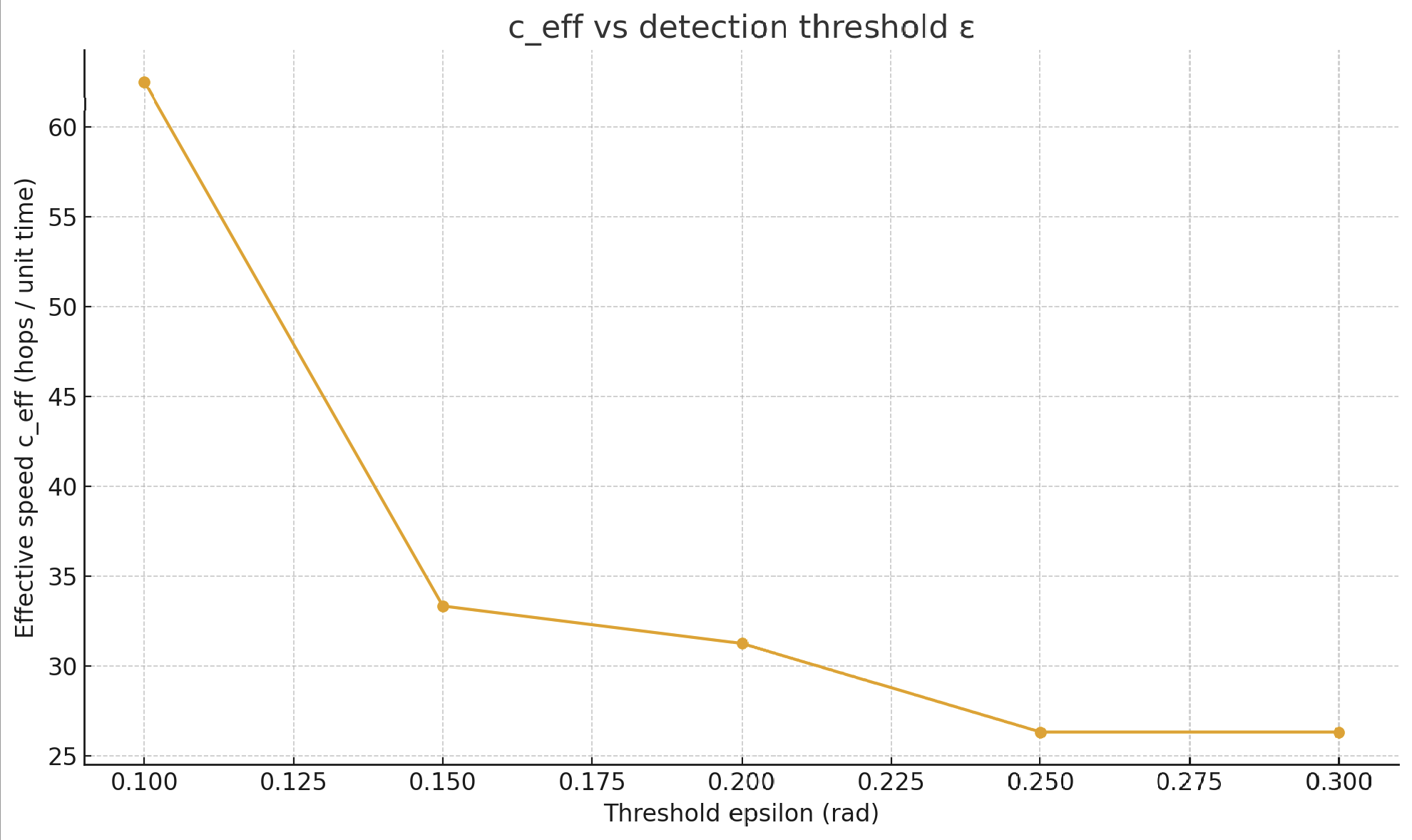
The detection threshold ε determines when wavefront arrival is registered:
- ε=0.10 → ceff ≈ 63
- ε=0.20 → ceff ≈ 31 (stable regime)
- ε ≥ 0.20 → consistent propagation speeds
6. Choren Term (λC)
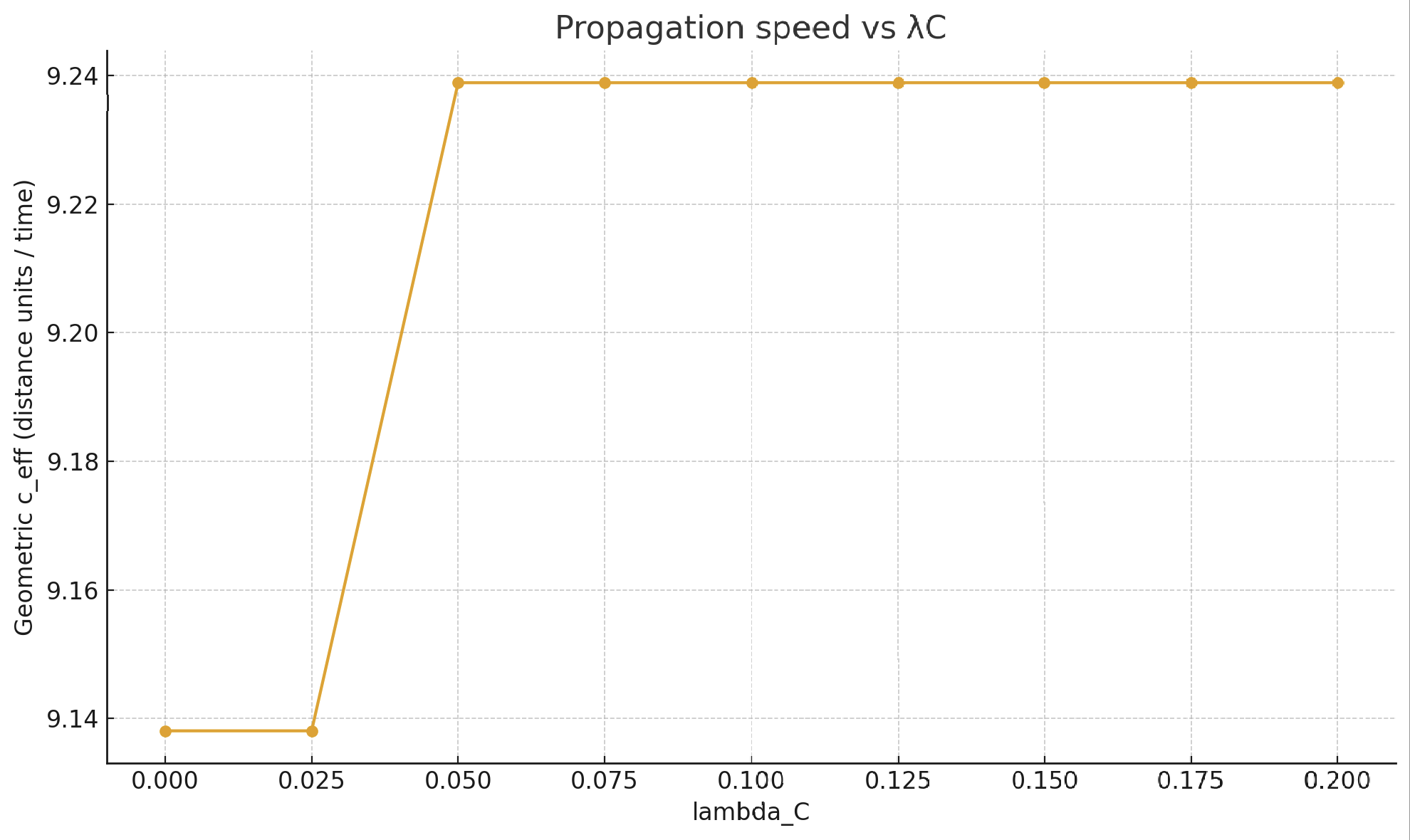
Introducing λC modifies both coherence and propagation:
- Rend (phase alignment) increases with λC
- ceff rises slightly (≈9.14 → 9.24 distance/time)
Interpretation: λC acts as a coherence stiffener, enhancing alignment without significantly altering speed in the tested regime (0–0.20).
7. Discussion
Our results unify three pillars: (1) Neighborhood Principle (k≈12), (2) Finite-speed phase waves as emergent light, (3) Choren Term linking dynamics to consciousness. Together, they suggest spacetime is best understood as a discrete-relational network, where geometry, light, and consciousness co-emerge.
8. Conclusion
The Essence Network offers a testable, philosophical-physical synthesis. By combining discrete topology with spinor dynamics, we recover relativistic-like light propagation and explore new couplings to consciousness. This work opens pathways from cosmology to neuroscience, offering a unified view of motion.